Git & GitHub
Tools for robust, collaborative coding
Last Time
dplyrverbs take a data frame as their first argument and return one.slice()select()filter()mutate()arrange()summarize()
Key Ideas for Today
- git tracks changes to files.
- A repository (repo) is a directory tracked by git.
- The staging area holds changes for a snapshot.
- A commit is a snapshot of staged changes with a message.
- A remote is a web-hosted repo (GitHub) you push to and clone from.
Computational Toolbox
- Unix Shell: Organize and edit file system.
- R: Computational enrivonment to make data products to write to file system.
- git: Track changes to files on files system.
git

- Free and open-source command line tool
- Developed to help coordinate collaborative coding
- 99% of software projects use it
- Many scientific projects use it
What does it do?
git allows you to
save your work,
document your process,
share it and,
collaborate with others.
Repository
A directory whose changes are tracked by git. Also called a “repo”. Initialized with git init.
Staging Area
The set of changes queued up to be included in the next snapshot. Files are moved into it with git add.
Commit
A snapshot of the files in the staging area, saved with a descriptive message. Created with git commit -m.
Git commands to get started
Each command is called from the command line following git (e.g. git init).
init: initialize a repository (repo)add: move a file into the staging areacommit: take a snapshot of files in the staging area with a message (-m)push: send commits to another repo
init: invite the photographer (git) to the wedding (repo)add: move the bride and groom into the camera framecommit: take a picture of the bride and groom and caption itpush: share the photos online

Example 1: Demo Project
- Create new directory for my project.
- Move into that directory.
- Initialize git repo.
- Create file using
echocmd (not git). - Add file to staging area.
- Commit the change with message.
- Create new directory for my project.
- Move into that directory.
- Initialize git repo.
- Create file using
echocmd (not git). - Add file to staging area.
- Commit the change with message.
- Make changes to file.
- Create new directory for my project.
- Move into that directory.
- Initialize git repo.
- Create file using
echocmd (not git). - Add file to staging area.
- Commit the change with message.
- Make changes to file.
- Add file to staging area.
- Commit the change with message.
- Create new directory for my project.
- Move into that directory.
- Initialize git repo.
- Create file using
echocmd (not git). - Add file to staging area.
- Commit the change with message.
- Make changes to file.
- Add file to staging area.
- Commit the change with message.
- View the commit history.
Guess the Metaphor
A tracking files on git is like wandering into Medusa’s Lair: first you walk into the lair (git add) then she petrifies you where you stand (git commit).

Terracotta Warrior of Xian
GitHub
What does it do?
git allows you to
save your work,
document your process,
share it and,
collaborate with others.
GitHub
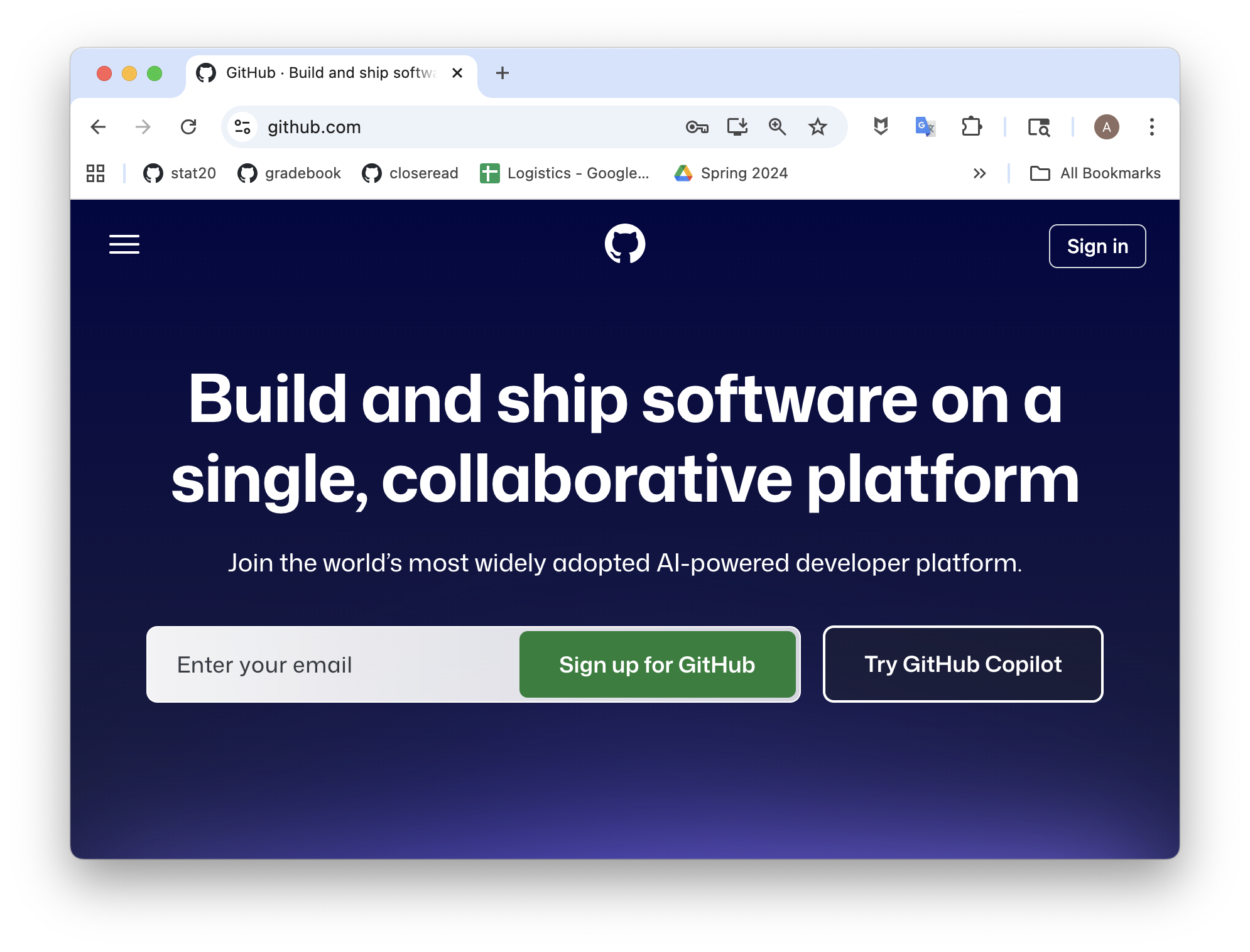

GitHub
- Allows you to create web-hosted repos to share with others
- “Facebook for coders”
- Individuals or projects have their own accounts/profiles
- Can follow one another
Create a repo
Live coding to set up https://github.com/andrewpbray/demo-project.git
Sharing your work
Sharing your work
Remote
A web-hosted copy of a repository (e.g. on GitHub) that you link to with git remote add and sync with git push. The default name is origin.
Project Workflow
Survey
- Prompt you to set up GitHub account.
- Guide you through git installation.
- Guide you through git configuration.
Project Workflow
boardwork
Key Ideas for Today
- git tracks changes to files.
- A repository (repo) is a directory tracked by git.
- The staging area holds changes for a snapshot.
- A commit is a snapshot of staged changes with a message.
- A remote is a web-hosted repo (GitHub) you push to and clone from.
For Next Time
- Quiz 2: 9/21-9/22.
- Complete the git setup survey (GitHub account, install, configuration).
- Project 2 is nigh!